
September 2, 2014

August 26, 2014

August 25, 2014

August 22, 2014
DOG DAYS
Until a couple of weeks ago I measured my life in dog-shaped days. Not my entire life. But the past five years of it. And now that Fred is dead my days are haunted by shapelessness. I expected to miss him but I didn't expect this.
We had Fred for 14 years and he was diabetic for the last five years of his life. When diabetes happened, insulin happened, needles happened, blood sugar testing happened (but only after catching Fred's first morning pee in a ladle). It gave a pronounced terrier shape to the day.
Which was not an altogether bad thing because around that time my days needed shaping. I'd recently lost my job at the mismanaged company where I worked for most of our time in Texas.
That wasn't an altogether bad thing either because the bombastic, myopic, erratic, neurotic, narcissistic mismanager of the company had me desperately seeking therapy in lieu of suicide. I wanted to quit the job. My very practical wife thought I meant quit in a couple of years when I could retire. I meant RIGHT NOW! before it kills me. I didn't make myself as clear as I needed to. She had worked hard, earned her Ph.D., had things she wanted to do and said she wanted the time to do them. Because I love her, I agreed, but we lived on separate psychic timelines for a while after that. We'd never done that before in our long and happy life. But I kept working, kept going to therapy (so I could keep working). Besides, the erratic, neurotic, narcissistic, etc. mismanager paid pretty well and the health insurance was good (the therapist liked that part).
Then suddenly, surprisingly, the job ended. A guy called me at home to tell me. It was good old Darryl, the ever faithful company guy who would lose his own job to the same mismanaged mess not long after that. Mr. Erratic, Neurotic, Etc., who recently had assured me that he couldn't imagine the company without me and that I could work there as long as I wanted to, never did his own shit work. I was out. And that was that. It was all over but the unemployment checks. I was too furious at the duplicity of it to feel relieved.
I suppose my anger gave my days some shape, but it didn't last. While my wife worked I sank into shapeless days of television, seeking narrative relief for the interrupted job-shaped story of most of my life. Then Fred became diabetic and ladling pee, testing blood sugar and poking needles gave me something to do every day. It still left plenty of time for television. Then, on a day when my wife was away working in Rhode Island and I was watching rerun after rerun of Law and Order on cable TV and eating peanut-buttered saltines, Fred looked up at me from his bed beside my chair and I watched him go blind. It was among the saddest things I'd ever seen and there was nothing I could do to stop it. It was over in a few minutes.
That's when my days took on the dog shape they kept until a couple of weeks ago. They were noisy days from the first. Fred was a good blind dog, but he was a blind dog. He had a talent for understanding words and following directions and I talked him through his blindness. He listened and was remarkably independent for a long time, but grew more and more insecure and dependent as time passed. My days became smaller and smaller as Fred's needs grew larger. He lost his sense of direction. I had to talk to him more and more to get him through his days but he seemed to understand what I was saying less and less. When I got out of bed in the mornings I stepped into a deep terrier-shaped hole. At least that's how it felt by the end.
That was two weeks ago.
Now when I get out of bed I step onto unexpectedly unfamiliar ground. I have been spending my shapeless days lost in a bigger and sadder place. And there have been some days too devoted to TV (narrative relief of the Law and Order sort), but I know they will end. And I know I am not really on unfamiliar ground. I've been here before. I am standing in that undefined and too quiet spot where the dead always leave the living. It is the place where life goes on and things shape up. I know that. I just don't know what new shape my days will take when that happens.
 |
Eric munches, Fred watches |
Which was not an altogether bad thing because around that time my days needed shaping. I'd recently lost my job at the mismanaged company where I worked for most of our time in Texas.
That wasn't an altogether bad thing either because the bombastic, myopic, erratic, neurotic, narcissistic mismanager of the company had me desperately seeking therapy in lieu of suicide. I wanted to quit the job. My very practical wife thought I meant quit in a couple of years when I could retire. I meant RIGHT NOW! before it kills me. I didn't make myself as clear as I needed to. She had worked hard, earned her Ph.D., had things she wanted to do and said she wanted the time to do them. Because I love her, I agreed, but we lived on separate psychic timelines for a while after that. We'd never done that before in our long and happy life. But I kept working, kept going to therapy (so I could keep working). Besides, the erratic, neurotic, narcissistic, etc. mismanager paid pretty well and the health insurance was good (the therapist liked that part).
Then suddenly, surprisingly, the job ended. A guy called me at home to tell me. It was good old Darryl, the ever faithful company guy who would lose his own job to the same mismanaged mess not long after that. Mr. Erratic, Neurotic, Etc., who recently had assured me that he couldn't imagine the company without me and that I could work there as long as I wanted to, never did his own shit work. I was out. And that was that. It was all over but the unemployment checks. I was too furious at the duplicity of it to feel relieved.
I suppose my anger gave my days some shape, but it didn't last. While my wife worked I sank into shapeless days of television, seeking narrative relief for the interrupted job-shaped story of most of my life. Then Fred became diabetic and ladling pee, testing blood sugar and poking needles gave me something to do every day. It still left plenty of time for television. Then, on a day when my wife was away working in Rhode Island and I was watching rerun after rerun of Law and Order on cable TV and eating peanut-buttered saltines, Fred looked up at me from his bed beside my chair and I watched him go blind. It was among the saddest things I'd ever seen and there was nothing I could do to stop it. It was over in a few minutes.
That's when my days took on the dog shape they kept until a couple of weeks ago. They were noisy days from the first. Fred was a good blind dog, but he was a blind dog. He had a talent for understanding words and following directions and I talked him through his blindness. He listened and was remarkably independent for a long time, but grew more and more insecure and dependent as time passed. My days became smaller and smaller as Fred's needs grew larger. He lost his sense of direction. I had to talk to him more and more to get him through his days but he seemed to understand what I was saying less and less. When I got out of bed in the mornings I stepped into a deep terrier-shaped hole. At least that's how it felt by the end.
That was two weeks ago.
Now when I get out of bed I step onto unexpectedly unfamiliar ground. I have been spending my shapeless days lost in a bigger and sadder place. And there have been some days too devoted to TV (narrative relief of the Law and Order sort), but I know they will end. And I know I am not really on unfamiliar ground. I've been here before. I am standing in that undefined and too quiet spot where the dead always leave the living. It is the place where life goes on and things shape up. I know that. I just don't know what new shape my days will take when that happens.
August 12, 2014
FRED: THE INSUFFICIENCY OF TEARS
Our dog Fred died a couple of days ago. He was about 15 years old - ours for 14 of those years - blind, diabetic, arthritic, incontinent, he trembled, had trouble standing, limped when he walked, had to be carried outside, was disoriented, confused, sometimes (often) needed to go outside in the middle of the night but sometimes still peed on the carpet because he couldn't help it, had begun to pant when he walked even short distances. After years of living fearlessly as a blind dog in a big world, his world grew smaller and more insecure by the day over the past few months. Many days lately he seemed to labor at simply staying alive and by the end he didn't have energy for much more than that. We decided it was time to take that little bit away too.
We think people who call themselves pet parents insult both pets and parents. We are dog owners. Ending Fred's life would not be like killing one of our children. But it would be killing something we loved, something we had worked hard for years to keep alive. It was not an easy decision.
I do not believe the dead go to a better place. This is the place and this is the one life any living thing has. After that there is nothing. Of course, the good thing about nothing is that we do not know we have arrived when we get there. But taking away life is taking away everything. Forever. That is not an easy thing to do. We wrestled with it, discussed it, worried it, measured his life and ours, measured his pain and ours, measured his loyalty and ours. "It is what I would want you to do for me. I expect it," Dauna said. I expect nothing less from her. There comes a time when the best thing to do is an act of terrible kindness that never can be undone. We decided it was the best thing we could do for Fred.
We made an appointment for 11:30 last Saturday (making such an appointment was disconcerting). Fred loved to ride in the car and we decided that is where it would be appropriate for him to spend his final minutes. He was calm as we drove him to the veterinarian's office. We parked in the shade of a juniper tree. His bed was in the back seat. Dauna sat beside him. We petted him, talked to him. He was quiet. He never particularly liked strangers touching him, but he remained calm when the vet leaned into the car and petted him, too. She explained the process and made sure we knew what we were doing. It was clear that she understood the difficulty of our decision. She gave Fred a sedative. He slept deeply, quickly, and we could only hope he heard our final goodbyes. The vet came back about 10 minutes later with an assistant, found a vein, gave him another injection - at any time up to that very moment we could have stopped what was happening, but we had agreed it was time to do what we were doing and had labored over the decision for weeks, even earlier that day. Neither of us said stop. In a few minutes, peacefully, quietly, his heart stopped beating and we were in tears.
I had dug his grave between two cactuses the day before. It seemed an appropriate place because Fred had a knack for stumbling over cactuses when he went out hiking with us (something else he couldn't do any longer). It wasn't easy because there is so much disintegrating granite in the soil here and my back still aches a little from swinging the pick and hoisting the shovel, but I dug it deep enough and wide enough, comfortable enough (that's how I thought about it). We brought Fred home and gently put him in the grave wrapped in a favorite blanket and covered him up. My wife fashioned a marker from dead cholla cactus branches, attached his tag to it and we walked away. It was a sad afternoon.
A little later I walked across the arroyo and up the hill alone. Why? I wasn't sure. But it felt like the right thing to do. I stood over the grave and made sure the dirt was snug around him one more time, pressing, packing it with my foot. I turned to walk away. Stopped. Looked down and said, "I'm sorry." I didn't intend to say that, but it was all I could do with my sadness when tears were not enough.
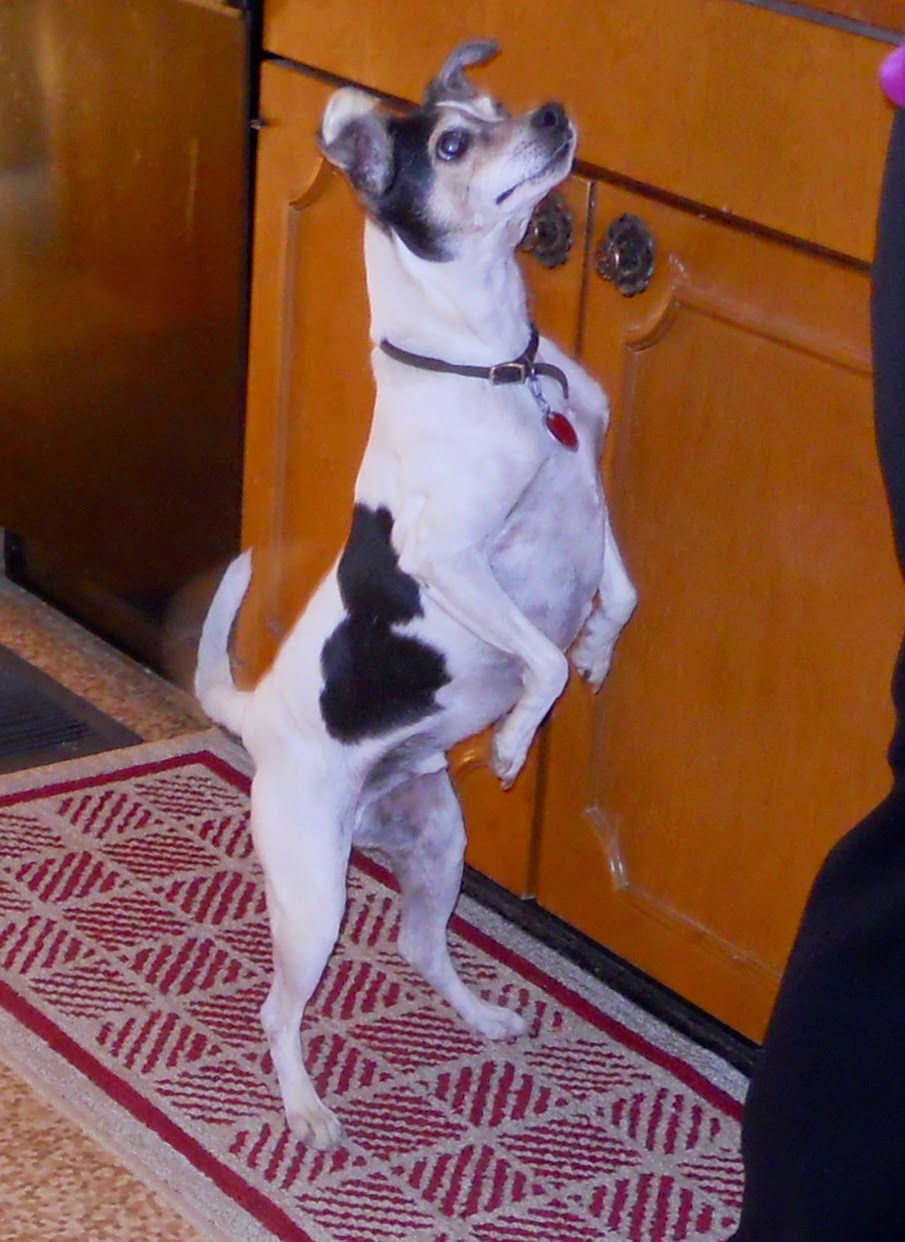 |
| Fred begging for cucumbers |
I do not believe the dead go to a better place. This is the place and this is the one life any living thing has. After that there is nothing. Of course, the good thing about nothing is that we do not know we have arrived when we get there. But taking away life is taking away everything. Forever. That is not an easy thing to do. We wrestled with it, discussed it, worried it, measured his life and ours, measured his pain and ours, measured his loyalty and ours. "It is what I would want you to do for me. I expect it," Dauna said. I expect nothing less from her. There comes a time when the best thing to do is an act of terrible kindness that never can be undone. We decided it was the best thing we could do for Fred.
We made an appointment for 11:30 last Saturday (making such an appointment was disconcerting). Fred loved to ride in the car and we decided that is where it would be appropriate for him to spend his final minutes. He was calm as we drove him to the veterinarian's office. We parked in the shade of a juniper tree. His bed was in the back seat. Dauna sat beside him. We petted him, talked to him. He was quiet. He never particularly liked strangers touching him, but he remained calm when the vet leaned into the car and petted him, too. She explained the process and made sure we knew what we were doing. It was clear that she understood the difficulty of our decision. She gave Fred a sedative. He slept deeply, quickly, and we could only hope he heard our final goodbyes. The vet came back about 10 minutes later with an assistant, found a vein, gave him another injection - at any time up to that very moment we could have stopped what was happening, but we had agreed it was time to do what we were doing and had labored over the decision for weeks, even earlier that day. Neither of us said stop. In a few minutes, peacefully, quietly, his heart stopped beating and we were in tears.
I had dug his grave between two cactuses the day before. It seemed an appropriate place because Fred had a knack for stumbling over cactuses when he went out hiking with us (something else he couldn't do any longer). It wasn't easy because there is so much disintegrating granite in the soil here and my back still aches a little from swinging the pick and hoisting the shovel, but I dug it deep enough and wide enough, comfortable enough (that's how I thought about it). We brought Fred home and gently put him in the grave wrapped in a favorite blanket and covered him up. My wife fashioned a marker from dead cholla cactus branches, attached his tag to it and we walked away. It was a sad afternoon.
A little later I walked across the arroyo and up the hill alone. Why? I wasn't sure. But it felt like the right thing to do. I stood over the grave and made sure the dirt was snug around him one more time, pressing, packing it with my foot. I turned to walk away. Stopped. Looked down and said, "I'm sorry." I didn't intend to say that, but it was all I could do with my sadness when tears were not enough.
January 30, 2014
HERE I GO AGAIN

I haven't written anything here since last October because I have been writing other things. Lots of other things, fiction, mostly short stories, some of them not so short. And I have been seriously attempting - for the first time in years - to get some of the stories published. This is what I did for many years before my wife and I met 27 years ago. She was a student in a writing class I was teaching. I was having some success back then and had been having some success for several years. But I wasn't happy about it. Being a writer is not a happy way to live. My wife once asked why she never hears me laughing when I am writing funny things. Laughing is for readers not writers. Besides, too much misery goes into even the happiest sentence. When we decided to be married, I decided to retire my misery and allow myself to be happy. And I did. And I am. And I have been for all these years.
Not that I haven't written in all that time. I never stopped.
But now I am back at it in the old way. Steady. Every day. I even published something a couple of weeks ago. It is a story called "Raining Indians" and it is not a happy story . But who could write a happy story set in Gallup, NM? It is the first time I've published a short story in a long time and the first time in an online publication. It's called the Provo Canyon Review. Go to the site, click on the story title. That's all it takes. I like it.
I had a good career as a journalist and editor (with a very strange and unintended finish as a corporate vice president for a business doomed by its maniacal founder and CEO). I had a knack for it. All of it. In fact, I had a talent for it. My old therapist (who saved me from my encounter with the maniac or at least made it possible for me to save myself) once said my journalism career was taking the easy way out and jerked me up short. "You have a gift," he said. "Journalism was easy. Using your gift is difficult."
Now I've retired from journalism. And here I am again. Putting myself in difficulties. And enjoying wrapping my old misery in my gift of language and sending it where it belongs - out on its own. My wife encourages me to keep going but I know she will not love me any less if I stop. All of my years of happiness with her have made a difference for both of us. Joy has returned to writing things down. It took a long time. And the time has come. But this is not what I expected to do. I'm retired.
October 23, 2013
DRIVE, HE SAID/SHE SAID/WE SAID
There was a time when all
someone had to say was, “Let’s go" (somewhere, anywhere), and I would have hopped in the car and said impatiently,
“When are we leaving?” And once the trip was underway I never asked, "Are we there yet?" The joy was in the going, not the getting there, in the passing through, never in the staying. I stopped a few times but never stayed for long. Stopping brings regret. Going does not. Regret doesn't travel well. So I went. And kept going. And had no regrets.
Times change. Now it is going that brings regret. Stopping does not. And I have stopped in a place where I will stay. And it is difficult to leave, even for a few days. But I am on the move again.
Times change. Now it is going that brings regret. Stopping does not. And I have stopped in a place where I will stay. And it is difficult to leave, even for a few days. But I am on the move again.
October 4, 2013

September 30, 2013
FRIENDS AND THEN SOME

My oldest friend came to visit. We
missed our 50th high school class reunion while he was here. But I miss all
high school reunions; he went only to the 40th. None is enough for me, one must
have been enough for him. What's left of the old class can re-une all they
want. We were happy here in New Mexico.
We have been friends for more than 60 years and met the day I became the new kid in Miss Martinelli's combined second-third grade class at Sternberger Elementary School. That's where I ended up because my parents wouldn't allow the school to jump me directly to third grade. I sometimes wonder how it might have changed my life to make the jump, but I ended up in the half-and-half class instead, second graders on Miss Matinelli's left, third graders on her right. Only the brightest second graders ended up in that class; I am not sure how the third graders qualified to be there. It was halfway through the school year when I arrived and the only thing my new classmates knew how to do that I didn't was cursive handwriting. That was for third graders back in the school I came from. Otherwise I'd done most of the reading and arithmetic at my old school.
Miss Martinelli said penmanship was important in life and I had to learn. Immediately. My mother assured her I would. We called it writing in longhand and I'd practice every afternoon making line after line of looping letters on wide-ruled paper. Big letters and little letters. Working my way through the alphabet and back, A-Z and Z-A. It was tedious, pencil-dulling work and I hated it, but I had to show it to my mother every day before I could go out and play with my new friend.
Then my aunts showed me how to fasten three pencils together with rubber bands so I could create three parallel lines of letters at a time. Three fat pencils angled just so, one rubber band. My mother's younger sisters were identical twins who had conspired to find an easy way to do anything and everything their whole lives. They began by charming their father then worked up from there. They were in their 20s when they showed me the pencil trick. Eventually the easy way out would become more and more difficult to find and they both became alcoholics. But their pencil trick made my life easier. I finished my handwriting homework in one-third the time and was given permission to go out and play with my best friend who lived up the road. My aunts winked as I walked out the door. We were co-conspirators and children love conspiracies more than handwriting.
My best friend's name is Durwood and we were friends at first sight. Same class, same school bus, same stop near the end of the school bus line at the edge of town. We were about one stop away from attending the county schools with the farmers' kids, but our parents would never have allowed it. We weren't country people. Our fathers had jobs in the city. We went to city schools and would have even better jobs in the city someday too. At least that was the plan. Eisenhower was president. What could go wrong? Life was good and could only get better.
Of course, times changed and people changed and the plans of the 1950s went awry in the 1960s and we went awry along with them. But before all that happened we had four years of freedom and friendship there at the edge of town: a pond to fish in, woods and fields for walking, a whole field full of rocks to throw. We learned to play chess and shared a love of Pogo comics. We lined up with everyone else for our polio shots. His house burned down while he was away at Scout camp. I watched it burn. His parents built a new one, ranch style, brick. I envied the fire and the new house. Sometimes when we slept over at his house or mine we were allowed to stay up late and watch Jack Parr. We were like brothers. Some people thought we were brothers
Then in the summer after sixth grade my family moved further into town. Durwood and I were no longer neighbors, but we always attended the same schools. We sang in a boys choir, played music in the school band. We bought identical Gibson LGO acoustic guitars. I had a guitar but he had the talent to go with it and eventually he learned to play far better than I ever would. He still came to my house, I went to his. Not as often, but often enough. Our friendship held fast.
After graduating from high school in 1963, both of us spent years climbing around in the wreckage of the 1950s, clung to adolescence through the 1960s and finally reached some semblance of adulthood sometime in the 1970s when we were nearly 30 years old. He became a banjo player, I became a writer. He once introduced me to his boss by telling her, "We tried to grow up together but didn't." His boss was country singer Loretta Lynn and we were on her tour bus somewhere in Iowa at the time. Durwood and I both laughed, but I am not sure she got the joke. Later he became a computer whiz and I became an executive. Through it all both of us remained boys who grew up just shy of the city limits, city boys with country longings.
As adults we've never lived in the same place and there are times we didn't see each other for years. But we have been friends since the day we met on the school bus and got off at the same stop in 1953. Now we have both retired to houses stuck on mountainsides, his in Tennessee, mine in New Mexico. My aunts are dead. My handwriting is strangely left-leaning (I am right handed), awkward and to this day I prefer to print when I have to write something down. I suppose I sacrificed penmanship to friendship but I have no regrets.
He is back home in Tennessee now and wrote today to say how much he enjoyed our time together. I wrote back, " The pleasure of your company is one of the truest pleasures of my life." What else could I say?

September 21, 2013
SO HERE WE ARE
I have done two things really
well in my life: I have loved my wife and loved New Mexico. They aren't the only two things I've done well, but they are the things I've done best, things without question, hesitation or deviation, things I will never regret.
And there are things I have done badly, too many things, but I have been thinking about one in particular.
I have not been a very good son and now that my father is 90 years old, I am no better at it than I ever was. I call him but I feel no need to go and visit; I catch myself in gestures that I recognize as his and promise myself I will never to do that again. Our lives are far away from each other and always have been, even when we lived in the same house.
Sometimes I think my mother intended it that way. I was born when she was 19 years old.
She gave birth to me and then befriended me and held on. A therapist once told me that a boy should not have to be his mother's friend, that being a son was enough. But that is what I was and perhaps it is most of what I was saving myself from when I went away and stayed away; but I was saving myself from my father too.
I was born shortly before Christmas when he was 21 years old and a damaged boy-man limping out of the wreckage of World War II. He says my birth made him happy and I believe him, but he never seemed to know how to be a father to me, never seemed to know quite what was supposed to happen between us. So I never learned. I watched him with his own father but they seemed as clueless as my father and me about what to do. Mainly the men in my family did not want to disappoint each other - grandfather (whose own father committed suicide when his son was seven months old), father (who went to war and never quite came home or really wanted to), son (who has resisted both war and suicide) - and fear of disappointment is a powerful thing but it is not love.
My mother always insisted that I respect my father, but she did not insist that I love him. When I lost my respect for him and he for me, there was not much left. We have tried. For years, especially in the seven years since my mother's death, my father and I have attempted to rescue love from years of mutual disappointment. We have not been very successful so far and we are running out of time. I am not sure we have the right tools. I am not even sure such tools exist.
So here we are.
He is a 90-year-old veteran of World War II who has spent much of his life embracing the war because he has never been sure how to embrace his children or anything else. It is the one thing he has done really well. So war is the beloved companion of his old age.
And I am 1,600 miles away in my beloved New Mexico with my beloved wife, determined not to be the prisoner of anybody's war, especially his.
Several hours away to the northwest I have one son; several hours to the southwest I have another. I embrace them; I love them; I am proud of them. There are no conditions. I do all of these things simply because I am their father and they are my sons. And I know they love me, too, though sometimes I fear I have disappointed them in some way. It is a fear I never want them to know. It is the third thing I want to do really well.
And there are things I have done badly, too many things, but I have been thinking about one in particular.
I have not been a very good son and now that my father is 90 years old, I am no better at it than I ever was. I call him but I feel no need to go and visit; I catch myself in gestures that I recognize as his and promise myself I will never to do that again. Our lives are far away from each other and always have been, even when we lived in the same house.
Sometimes I think my mother intended it that way. I was born when she was 19 years old.
 |
| The Veteran |
I was born shortly before Christmas when he was 21 years old and a damaged boy-man limping out of the wreckage of World War II. He says my birth made him happy and I believe him, but he never seemed to know how to be a father to me, never seemed to know quite what was supposed to happen between us. So I never learned. I watched him with his own father but they seemed as clueless as my father and me about what to do. Mainly the men in my family did not want to disappoint each other - grandfather (whose own father committed suicide when his son was seven months old), father (who went to war and never quite came home or really wanted to), son (who has resisted both war and suicide) - and fear of disappointment is a powerful thing but it is not love.
My mother always insisted that I respect my father, but she did not insist that I love him. When I lost my respect for him and he for me, there was not much left. We have tried. For years, especially in the seven years since my mother's death, my father and I have attempted to rescue love from years of mutual disappointment. We have not been very successful so far and we are running out of time. I am not sure we have the right tools. I am not even sure such tools exist.
So here we are.
He is a 90-year-old veteran of World War II who has spent much of his life embracing the war because he has never been sure how to embrace his children or anything else. It is the one thing he has done really well. So war is the beloved companion of his old age.
And I am 1,600 miles away in my beloved New Mexico with my beloved wife, determined not to be the prisoner of anybody's war, especially his.
Several hours away to the northwest I have one son; several hours to the southwest I have another. I embrace them; I love them; I am proud of them. There are no conditions. I do all of these things simply because I am their father and they are my sons. And I know they love me, too, though sometimes I fear I have disappointed them in some way. It is a fear I never want them to know. It is the third thing I want to do really well.
 |
| Father and Sons |
September 4, 2013
THE FATUOUS PHONY WHO LIVES DOWN THE LANE

The next day an email
arrived from the neighbor:
Hi again. I hope this message is not received as
"unfriendly" - it is not our intent!
We am (sic) requesting that you not hike
across our property or open the gate at the rear of our property to gain access
to our private driveway when you are hiking in the areas around our property.
The honest truth is that we just don't want our property - or our driveway - to
become part of anyone's hiking trail again. It has taken us the better part of 2 decades to stop the
many people who used to routinely hike through our property [along with their
horses, loose dogs, friends, family, house guests, etc.] as well as up and down
our private driveway at all hours of the day and evening.
Unfortunately, we have learned from
experience that when one person begins trespassing, then more and more
neighbors and hikers [many of whom are not neighbors] think they can do the
same thing and the trespassing problems begin all over again for us. Once
people start trespassing, they end up hiking all through our property and it
becomes simply too invasive of our privacy, and creates security issues - which
become truly troublesome for us as part time residents.
We can show you another access point ....
We understand the tensions these issues can
provoke among neighbors - so, please feel free to call me or email me if you
want to discuss this further.
Thanks for your understanding about our
request.
OK - on to something more fun. I will send
the pictures ... of the bear shortly.
And, let me know if you do want some of the
bounty from our tomato crop when it comes in!
Thanks!
I love the way she chattily
chirped “Hi again” then put quotation marks around the word “unfriendly” to
show us she didn’t mean it that way. But she did mean it that way. She is
unfriendly, un-neighborly, unwilling to simply ask us politely to find a different
way to the start of the trail. But she was perfectly willing to make excuses (“The
honest truth is...”) and feel compelled to give us the history of their decades
long fight for privacy (the honest truth is I don’t give a shit about that and
why didn’t they just build a fence after the first decade or so) and have the
audacity to imply that if she let us get away with it even one time, there is
no telling what sort of riff-raff might follow on our trail (we are her un-riff-raffy
neighbors for fuck’s sake).
First there is the offer, "We can show you another access point ...." Then there is the use of "tensions," "issues," "provoke" and "neighbors" along with the invitation to "please feel free to call me or email me" to talk about it. Oh, please. We don't need for you to show us anything and there will be no further discussion.
This is it.
And finally the cheery,
fatuous fakery of the “on to something more fun” part? She can keep the picture
of the bear (she's scarier than the bear anyway) and stuff her tomato bounty with whatever or wherever.
My wife (always more kind
and courteous than I am, but someone who likes honest talk rather than weaselly
passive-aggressive emails) wrote back to say: Thanks for letting us know.... You should have said something
yesterday. We will find another route to hike because being a good neighbor is
important. To which our un-neighborly neighbor responded thanking us for
understanding because she really feels we might become friends.
Friends? We won’t become
friends because what we understand is that she is the sort of person we don’t
want to know, the sort who gives Santa Fe a bad name and who cannot understand
the pompous arrogance of sending an offensive message like this via email and
not expecting it to be seen as unfriendly and tension-making. She is the sort
of obliviously silly and condescending person we would never befriend.
Despite its long history as
a place where cultures collide, Santa Fe attracts all sorts of people who never
quite fit in someplace else. In fact, it is a place where those people can get
together, tolerate each other’s quibbles and quirks and call it home. Always
has been. People give each other lots of leeway here to dress, eat, sleep,
pray, philosophize, fleece, fake and marry however they please, as long as they
respect other people’s ability to do the same.
It's not always easy because some are more tolerable than
others, but there is one particular type that is intolerable.
It is the person from
somewhere else – Maryland, Virginia, perhaps, somewhere just outside D.C., a place like that –
skinny, white, in this case female (but not always), lives around here part
time, does a little volunteer work somewhere safe for people like her and believes that entitles
her to be a local, lives in a nice little place surrounded by trees up a dirt
road off Old Santa Fe Trail, is afraid of things that go bump in the night (or
day), fearful of strangers to the point of paranoia, yappy as a Pomeranian, untrustworthy
as a pit bull and as self-righteously selfish as Ayn Rand.
What a disappointment to
discover that one of those people is my "neighbor." But she is. The good thing is
she will be leaving soon for the tidy confines of wherever she confines herself
back east when she is not here. Maybe she won’t come back. She's clearly not from around here.
p.s. Being unfriendly is my intent.
p.s. Being unfriendly is my intent.
August 28, 2013
AUGUST 28, 1963: PAINFUL, CHILDISH THINGS
"When I was a child, I spake as
a child, I understood as a child, I thought as a child: but when I became a
man, I put away childish things." 1 Corinthians 13:11
August 28, 1963. Half way between graduation and assassination. People were marching in Washington, D.C., proclaiming their civil rights. Dr. Martin Luther King, Jr. would give a famous speech that day. I wished I could be there to hear it. My feelings were there, my heart was there, my mind was there. I watched it all on television. But I would have been there if I could. The truth is that I wasn't brave enough to grow up enough to be there. I was only a couple of months out of high school; JFK had less than three more months to live. I was not ready to put away the childish things that included all of the stuff accumulated during a white southern boyhood in North Carolina. I was several years away from becoming a man. But I could pretend, couldn't I? And I would do a lot of damage during that time searching for a box large and strong enough to hold the misery and mess of my youth long enough for me to get away.
I knew that's what it would take. I already knew it in August 1963 as I watched all those people gathered in front of the Lincoln Memorial listening to Dr. King speak. I wanted all their dreams to come true. I really did. I understood it all. Every word, every thought, every demand, every longing and need. I felt it. I knew it. I understood it intimately because I was dreaming my private dream of the day when I could shout/sing/scream/whisper/mutter, "Free at last. Free at last." We were all trapped together and it might take chewing our own legs off to escape. That is what I really understood. And that the chewing would be long and painful.
I was 18 years old, fresh out of high school and still too afraid of pain to do much to help myself or anybody else. So I spent the summer of 1963 clinging to childish things, but August 28 loosened my grip.
August 26, 2013
HERE AND NOW
I live in Santa Fe but I am not a Santa Fean. At least not
one of those prairie dog hugging, horse saving, crystal rubbing, chakra aligning,
farmers marketing, Whole Food shopping, micro brew drinking, lama raising, goat herding, hippy dippying, pound puppying, pet
parenting, chicken clucking, gluten avoiding, fragrance loathing, surgical mask
wearing, air filtering, contrail fearing, drone ducking, daily journaling, self diagnosing, bipolaring, O’Keeffe
worshipping, art snobbing, money toting, mansion building, Land Rover driving,
adobe craving, Meem miming, culture robbing, helicopter parenting, lawn
watering, gate locking, Santuario pilgrimming, Espanola hating, types. But I like it here. My wife likes it here. And we intend to stay. A pissed off, tow truck driving, small-time politician once called me a "hippie drifter" with all the fury and vocabulary he could muster. I think he meant it as an insult. I wasn't insulted. I always knew where home was. We've been other places, done other things and finally drifted back to where we are supposed to be. I documented the long, unhappy sojourn in Texas and the journey home on my old blog. There are all kinds of things to read, some of them about Santa Fe. Check it out. Then come back. I plan to be here a long time.

Subscribe to:
Posts (Atom)