Showing posts with label death. Show all posts

April 15, 2016

LIFE, LOVE, DEATH, MEMORY: FOR MY DEAD NIECE WHO DESERVES MORE THAN THIS

"I said I came into this world not wanted and I will go out not wanted." 
                               Ruth Howerton-Luck, January 26, 2016.


My niece Ruth Ann Howerton-Luck died April 2, 2016, nearly two years after being diagnosed with colon cancer that had metastasized to her liver. It kept metastasizing until it was everywhere from her lungs to her brain and ovaries. She tried to stop it and lived as long as she could through the pain and the nausea, the surgeries and chemo. On Jan. 30 she told me, "I will be gone in two or three months [because] my cancer is a rapid growing kind. I want to fight a little longer so Ryan and the girls have a mom." She fought. She was valiant and courageous, but no matter what she did, the cancer seemed to do one thing more, or two, or ten. It is what cancer does. She was a long time dying, and then she was a short time dying, and then she was dead. In that same Jan. 30 conversation she said, "I am not going to hospice. I mean it may look like a grand way to die but it really isn't." She had experience caring for the dying. On April 2 she died at home a few days after leaving hospital care. Her children were there, her brother, nieces and nephews, her stepmother. Her husband was there too.

It is now April 14 and no plans have been announced for a funeral or a memorial service and her family and friends cannot understand why. When news of her death was posted hundreds of people responded. People loved her, knew her, intimately followed her pain-wracked struggle, were sad for her, hopeful for her, awed by her. Now they want to share their love for her, bid her farewell, gather around their memories of her. We need to hear each other say things about her, weep together; her two daughters and her son need to say what they must and hear what they should about their mother. When? Where? Her husband spoke vaguely of "something in a few months." He has said nothing else. We don't even know what happened to her remains.

Meanwhile people talk, they text, we compare notes and messages Ruth left behind about her cancer and the misery heaped on top of the pain of her disease in the final months of her life gather into a stormy cloud. She needed for all of us to know what was happening besides cancer and made sure we did, but begged people to do nothing, say nothing, no matter how much we knew, fearing things would become worse for her and her son. We honored her request. Some of us wish we hadn't. Now that time has passed. She is dead and we are becoming impatient. The cloud is rolling and when the storm breaks it is likely to be ugly.

Ruth Ann Howerton was born in Greensboro, NC, to a teen-aged mother who already had one child by the time my brother married her. Her father was my brother John. He was a teen-ager too. It was an inauspicious beginning that grew worse as time passed. Ruth's brother was born a year or so later. Ruth's parents were hardly parents to their children at all. It is a tired old tale. They were children themselves, etc. It is an excuse. Sometimes my brother, his wife and children stayed with my parents in a house never meant for that many people because they had no money. It was crowded, noisy, always aswirl with people (mostly relatives of one sort or another. My grandmother lived next door). Sometimes they had their own place. Sometimes they left the children home alone for hours or days at a time while they went out to do the things childless teen-agers do. Their small children were left to fend for themselves and tend to each other the best they could. Their house - when they had one - smelled of dirty diapers and cigarette smoke. It was a shitty way to live and it couldn't last. They couldn't last. The life they were living caught up with them. My brother ended up in prison for something involving a carload of marijuana and an undercover cop. His wife found her own way and she didn't want her children along for the trip. Ruth and her brother were lost in the shuffle and seemed doomed to a life in foster care. Then, because my father insisted on it ("Nobody else is going to raise my grandchildren!"), they ended up with my parents. It was official. Signed, sealed and delivered. Abandoned children taken in to be raised by their grandparents.

The day that happened Ruth started looking for love. Abandoned children do that. She found it from time to time but it didn't last. She loved my mother (Ruth's Memaw, the only real mother she ever had) and was loved in return. She loved her children and they loved her. We loved her from near and far. She was not unloved and she was not unwanted. But she wanted more than that, she was greedy for it. She wanted more love closer to home. And she didn't believe she was receiving it. In the end, her fear of love lost seemed worse than her fear of dying. It was sad to watch.

Now, after the life she lived and the death she lived, the love she had and the love she craved, she deserves more than this. Soon.

 "I can't believe my life has come to this."
 Ruth Howerton-Luck, January 30, 2016

--------------------

NOTE: Since this piece was posted sketchy plans for a memorial service in Greensboro, NC, on May 14 have been posted. No further details have been announced.

December 2, 2014

MY FATHER IN HIS COFFIN

My father was a wisp when he died. There wasn't much left by the end, even less than when I last saw him alive a few weeks before and there wasn't much then. I doubt if he weighed 100 pounds. He declared himself "not sick, just old" and tucked the covers up around his chin, dozed off and left me to watch him sleeping. When he awoke from his nap he looked at me and said, "You don't have to worry about my funeral. It's planned and paid for." A couple of days later I went with him to physical therapy where he introduced me as "my oldest boy" one last time. A few minutes later I kissed him, told him I loved him and went to catch my plane. We both knew all of our time together - nearly 70 years - was over. I would not be there to watch him die; he would not need me there to watch. We knew that too. He didn't call out to me as I left and I didn't look back at him. There was no need.

Within days of my leaving he decided to be done with it. No more physical therapy (it wasn't improving things, at least not enough to matter and he knew it), no more forced doses of bad-tasting goop and glop, no more diaper changing or oxygen tubes. He was ready for hospice and hospice was ready for him, but he never got that far. He simply declared his independence, tucked his life up around his chin and died on a Friday night. He did it alone, not long after my brother's final visit.

He was 91 years old.

When I arrived for my final visit a few weeks before he didn't know I was coming. I walked into his room, kissed him firmly on the forehead and told him I loved him. I surprised us both. I had not kissed my father in years and still cannot remember when that might have been. I do not come from a very physically affectionate family. But men kissing men, men kissing boys, boys kissing boys. It is not what men do. Men kiss children and wives; men shake hands with other men, and with their growing sons. But I needed to kiss my father.

My sister called me later that evening to tell me my father said, "He walked in and kissed me right on the forehead." She said he was happy I did that, and it was important enough for him to mention it to her, and she found his happiness important enough to report it to me. That kiss meant something to him and to me. It was a rare and genuine thing, uncluttered by our kissless past.

The next time I saw him he was in his coffin.


August 12, 2014

FRED: THE INSUFFICIENCY OF TEARS

Our dog Fred died a couple of days ago. He was about 15 years old - ours for 14 of those years - blind, diabetic, arthritic, incontinent, he trembled, had trouble standing, limped when he walked, had to be carried outside, was disoriented, confused, sometimes (often) needed to go outside in the middle of the night but sometimes still peed on the carpet because he couldn't help it, had begun to pant when he walked even short distances. After years of living fearlessly as a blind dog in a big world, his world grew smaller and more insecure by the day over the past few months. Many days lately he seemed to labor at simply staying alive and by the end he didn't have energy for much more than that. We decided it was time to take that little bit away too.

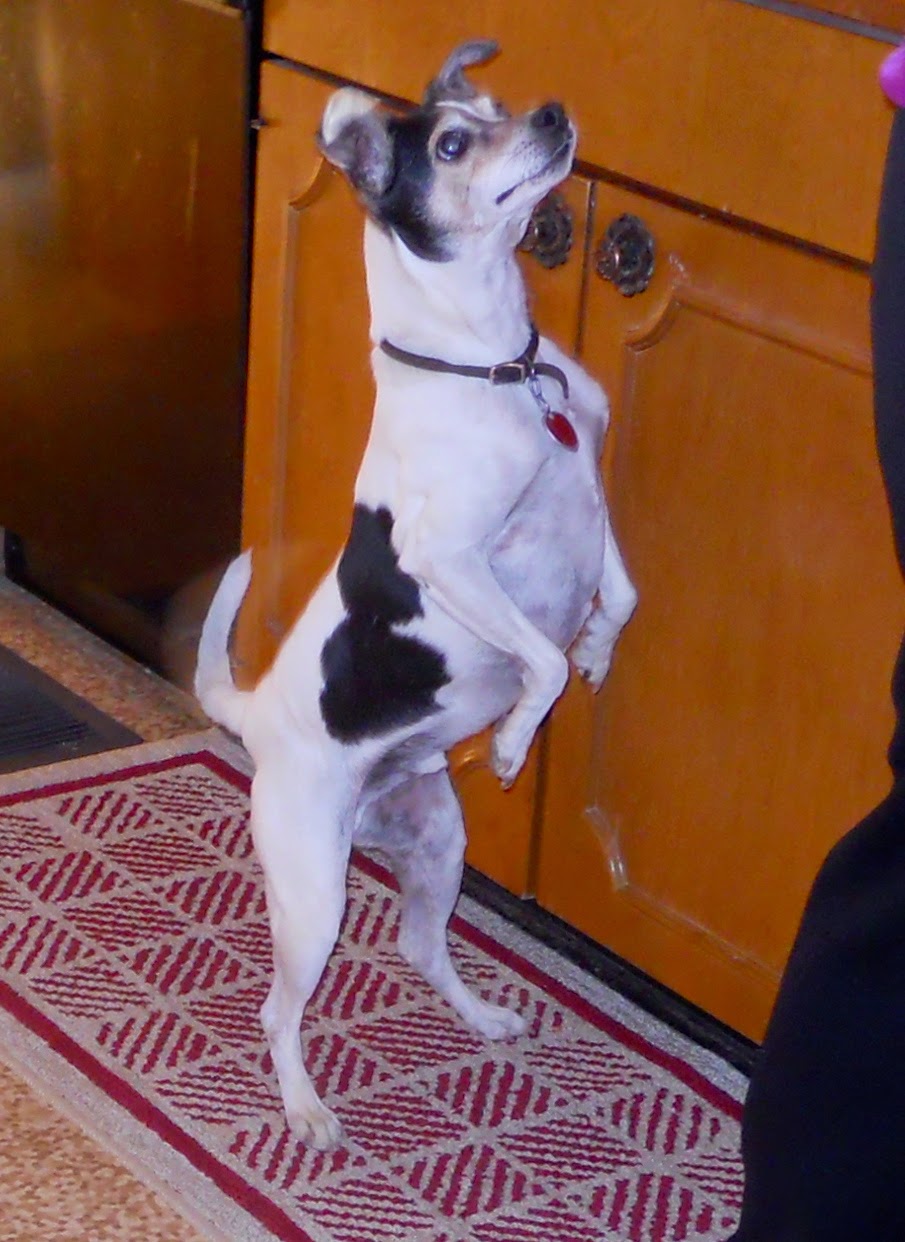
Fred begging for cucumbers
We think people who call themselves pet parents insult both pets and parents. We are dog owners. Ending Fred's life would not be like killing one of our children. But it would be killing something we loved, something we had worked hard for years to keep alive. It was not an easy decision.

I do not believe the dead go to a better place. This is the place and this is the one life any living thing has. After that there is nothing. Of course, the good thing about nothing is that we do not know we have arrived when we get there. But taking away life is taking away everything. Forever. That is not an easy thing to do. We wrestled with it, discussed it, worried it, measured his life and ours, measured his pain and ours, measured his loyalty and ours. "It is what I would want you to do for me. I expect it," Dauna said. I expect nothing less from her. There comes a time when the best thing to do is an act of terrible kindness that never can be undone. We decided it was the best thing we could do for Fred.

We made an appointment for 11:30 last Saturday (making such an appointment was disconcerting). Fred loved to ride in the car and we decided that is where it would be appropriate for him to spend his final minutes. He was calm as we drove him to the veterinarian's office. We parked in the shade of a juniper tree. His bed was in the back seat. Dauna sat beside him. We petted him, talked to him. He was quiet. He never particularly liked strangers touching him, but he remained calm when the vet leaned into the car and petted him, too. She explained the process and made sure we knew what we were doing. It was clear that she understood the difficulty of our decision. She gave Fred a sedative. He slept deeply, quickly, and we could only hope he heard our final goodbyes. The vet came back about 10 minutes later with an assistant, found a vein, gave him another injection - at any time up to that very moment we could have stopped what was happening, but we had agreed it was time to do what we were doing and had labored over the decision for weeks, even earlier that day. Neither of us said stop. In a few minutes, peacefully, quietly, his heart stopped beating and we were in tears.

I had dug his grave between two cactuses the day before. It seemed an appropriate place because Fred had a knack for stumbling over cactuses when he went out hiking with us (something else he couldn't do any longer). It wasn't easy because there is so much disintegrating granite in the soil here and my back still aches a little from swinging the pick and hoisting the shovel, but I dug it deep enough and wide enough, comfortable enough (that's how I thought about it). We brought Fred home and gently put him in the grave wrapped in a favorite blanket and covered him up. My wife fashioned a marker from dead cholla cactus branches, attached his tag to it and we walked away. It was a sad afternoon.

A little later I walked across the arroyo and up the hill alone. Why? I wasn't sure. But it felt like the right thing to do. I stood over the grave and made sure the dirt was snug around him one more time, pressing, packing it with my foot. I turned to walk away. Stopped. Looked down and said, "I'm sorry." I didn't intend to say that, but it was all I could do with my sadness when tears were not enough.