On my mother's side I come from a family of drinkers: boozers, dipsomaniacs, drunks, lushes, sots, alcoholics of various stripes and even a few pill poppers. My aunts and uncles were all short people and that probably compounded things. But the real problem was alcohol.
Lives were wrecked, people died - a besotted favorite aunt and a couple of innocent and sober strangers died in alcohol-bathed wrecks. One uncle went without a driver's license for
much of his life and booze was involved. Another uncle loved to get drunk, get insulted (he made sure that would happen), start fights in bars and end up in jail from time to time. His violent streak sometimes extended to family members, but they all insisted they still loved him because that is what people in that kind of family do. And they were that kind of family.
Some were loud and angry drunks. Others drank prodigiously and passed out quietly. Some married drunks. And one or two were private drinkers. My mother was one of those and probably angrier than the rest. She didn't begin drinking until I was grown and gone, but she drank her way through anger toward sleep for years. None seemed like happy drunks, but they all drunkenly, enthusiastically, splashed around in the shallow puddles of their own misery. Marriages suffered. Children suffered the way the children of drunkards always do and most of us have lugged it into adulthood in one way or another, never quite escaping no matter how far away we went or close to home we stayed.
My mother loved wallowing in the family mess with her brothers and sisters. And there always was plenty of it. Their mother encouraged it and made sure they always had something to wallow in. After she died most of them didn't know any other way to live and kept on wallowing. They were a family rich in secrets, lies and liquor. A few slipped away eventually, but not many.
I do not like the wallow of family mess and stay far away from it. And after growing up around those people, I have a complicated relationship with the whole idea of family, particularly extended family, and it took many years of my life to escape my own secrets and lies (I thought that was the way life was supposed to be lived. Why wouldn't I?) and enjoy family life.
I have always been wary of family but I have never been wary of alcohol. In spite of everything, I do not have a complicated relationship with alcohol. I like to drink. I've spent my entire adult life proving how much I like it.
Beer is where I started when I was old enough to drink legally (18 years old in those days). There were only beer bars where I grew up and I was a regular at several. I don't remember drinking much whiskey back then, but I must have
because I remember puking so much bourbon and Coke out of car windows that I didn't drink bourbon - or Coca Cola - for years. I couldn't even stand the smell. Beer was my drink of choice. I even carried an opener - a church key - on my key ring until poptops came along. After training on Pabst Blue Ribbon for a few years (a good training beer if ever there was one) I moved on to tastier, sturdier fare. Budweiser. Tall cans. Imported beer. Dark beer. Guinness stout. The stronger tasting the better. If I drank whiskey it was scotch, but that was rare.
I like to drink but I do not like to be drunk. It happens but not very often. And I have a very low tolerance for drunks and staggering drunken behavior. Both of those things are no doubt linked to the people I grew up around. But the way I see it, I drink the way I do in spite of them, not because of them. I have a taste for it, but I do not have a thirst for it. I do not crave alcohol or develop a mighty thirst if I quit drinking for a while - and I have quit at times. I do not get drunk and go looking for a fight; I do not get drunk and descend on some unsuspecting friend or relative like the raging, weeping drunks who showed up at my parents' house in the middle of the night too frequently when I was growing up - usually after the bars closed or the bottle was empty; I do not get drunk, pass out on the floor and have to be dragged to my bed by friends or relatives. I do not get drunk and behave badly. I do not drink alone or early or instead of doing other things. Drinking and driving used to be a way of life (we all did it), but I don't even do that any more.
And nowadays I
particularly like to drink bourbon. I guess the beer years washed the pukey bourbon memories away. A few years ago I bought a bottle and enjoyed it. I like the taste. Bourbon, a little ice, a little
water. Several of those each evening. Along with a little conversation
with my wife. Drinking has been part of the rich conversation we have kept going for approaching 30 years and I have to admit I even offered her a little bourbon the first time she came to my house (not a social visit, but I was wishing it was), which she rejected with the promise that she would come back and we would have that drink later and she did and we did and still do. Add a little music, some TV, a book, a movie, a sunset, a fire in the fireplace, a starry sky. Add whatever you like, but don't add anything to the whiskey but a little water and a little ice.
I drink but I am not an alcoholic. I am confident of that fact. It allows me to go on drinking. And every drink I take proves I am not like them. I do not do any of the things I watched my mother and her brothers and sisters do. If I did, I would quit drinking tomorrow. Or maybe the day after. But the truth is I have no plans to quit at all. Happy hour starts at five o'clock around here.
October 15, 2014
October 6, 2014
QUARANTINE: THINKING ABOUT EBOLA
Our house was once quarantined because I was sick.
I had a sore throat and a fever, but I was a child prone to strep infections, so a sore throat and fever were nothing new. But this sore throat rapidly became worse than it ever had been before, my fever went higher, my tongue coated white, I had chills and broke out in a sand-papery red rash. My mother took me to the doctor. We rode the bus because we didn't have a car back then. The doctor said I had scarlet
fever and that my mother shouldn't take me home on the bus. He said scarlet fever was a dangerous, contagious illness and that it was his job - and our job - to make sure other children didn't catch it. He said go home and stay home and said I had to stay in bed and rest. My mother took me home - I don't remember how we got there - and tucked me in, pulled the shade, turned out the light, kissed me on my feverish forehead and told me to call her if I needed anything. She went to take care of my baby sister, who could not visit until I was well. The county health department came by not long after that and tacked a big yellow quarantine sign on our front door. It was a serious sign. And we obeyed it. Other people obeyed it too. We stayed put and they stayed away. No questions asked.
I was six years old. I would remain in bed for the better part of a month before the sign came down. Scarlet fever is a childhood disease that once killed many children and left others with damaged hearts and other disabling problems. It also is an illness that could panic whole neighborhoods, towns and schools when it turned up. Antibiotics eventually calmed both the illness and the fears - though the illness remains a danger without early treatment - but not in 1950 when I was sick. So the quarantine sign on our front door told the neighborhood - and the world - I was sick but not to worry, things were under control, a line had been drawn, a perimeter set up, their children were safe.
I was confined to my bed in a darkened bedroom and could only leave to go to the bathroom. I am not sure why the room was kept dark, but for days I was too sick to care. Nausea, fever, sore throat, headaches, the rash. The doctor came to check on me from time to time. My mother fed me soup; I drank ginger ale (our family's traditional nausea remedy).
And there was medicine. Awful tasting. Probably penicillin. Liquid. Several gagging doses a day. I hated it. I resisted. Finally I hated it so much I hid my red and white plastic dart pistol under my pillow and when my father came in with my evening dose and turned on the lamp, I jerked the pistol out and said, "If you try to make me take that I am going to shoot you."
My father, who had been a soldier in Italy in World War II only a few years before, took shooting and threats of shooting seriously. He also knew taking your medicine was serious business. He came down with rheumatic fever a few weeks after the Salerno invasion, spent a year in a hospital and barely survived. He calmly handed the medicine bottle and the spoon to my mother, snatched the little pistol out of my hand, jerked me up by the arm and, as I dangled over the bed, smacked my butt several times so hard that I never had trouble taking my medicine again. Ever. He said nothing. He spooned, I swallowed, he left the room. My mother dabbed at my tears with the corner of the sheet, tucked me in and turned off the lamp. I never saw the little red and white pistol again.
Years later I met a guy who was a kid down the block I never knew back then. He remembered those quarantine days,
remembered being told by his parents to stay away from my house, to cross to the other side of the street when walking past, remembered boys daring each other to sneak up to my front door and touch the quarantine sign, remembered touching the sign himself, the thrilling feeling of tempting death, and running home to await his fate.
I recovered and infected no one else. The quarantine sign came down and no others went up.
I have been thinking about all of that recently. About the quarantine. About the way we stayed put and others stayed away. About how I took my medicine. About how I lived and the rest of the kids in the neighborhood went on living too. And about the deadly seriousness of Ebola and the dangers of playing at tempting death on a dare, like neighborhood children.
I had a sore throat and a fever, but I was a child prone to strep infections, so a sore throat and fever were nothing new. But this sore throat rapidly became worse than it ever had been before, my fever went higher, my tongue coated white, I had chills and broke out in a sand-papery red rash. My mother took me to the doctor. We rode the bus because we didn't have a car back then. The doctor said I had scarlet
![]() |
| I understand this look. |
I was six years old. I would remain in bed for the better part of a month before the sign came down. Scarlet fever is a childhood disease that once killed many children and left others with damaged hearts and other disabling problems. It also is an illness that could panic whole neighborhoods, towns and schools when it turned up. Antibiotics eventually calmed both the illness and the fears - though the illness remains a danger without early treatment - but not in 1950 when I was sick. So the quarantine sign on our front door told the neighborhood - and the world - I was sick but not to worry, things were under control, a line had been drawn, a perimeter set up, their children were safe.
I was confined to my bed in a darkened bedroom and could only leave to go to the bathroom. I am not sure why the room was kept dark, but for days I was too sick to care. Nausea, fever, sore throat, headaches, the rash. The doctor came to check on me from time to time. My mother fed me soup; I drank ginger ale (our family's traditional nausea remedy).
And there was medicine. Awful tasting. Probably penicillin. Liquid. Several gagging doses a day. I hated it. I resisted. Finally I hated it so much I hid my red and white plastic dart pistol under my pillow and when my father came in with my evening dose and turned on the lamp, I jerked the pistol out and said, "If you try to make me take that I am going to shoot you."
My father, who had been a soldier in Italy in World War II only a few years before, took shooting and threats of shooting seriously. He also knew taking your medicine was serious business. He came down with rheumatic fever a few weeks after the Salerno invasion, spent a year in a hospital and barely survived. He calmly handed the medicine bottle and the spoon to my mother, snatched the little pistol out of my hand, jerked me up by the arm and, as I dangled over the bed, smacked my butt several times so hard that I never had trouble taking my medicine again. Ever. He said nothing. He spooned, I swallowed, he left the room. My mother dabbed at my tears with the corner of the sheet, tucked me in and turned off the lamp. I never saw the little red and white pistol again.
Years later I met a guy who was a kid down the block I never knew back then. He remembered those quarantine days,
![]() |
| My sign was yellow. |
I recovered and infected no one else. The quarantine sign came down and no others went up.
I have been thinking about all of that recently. About the quarantine. About the way we stayed put and others stayed away. About how I took my medicine. About how I lived and the rest of the kids in the neighborhood went on living too. And about the deadly seriousness of Ebola and the dangers of playing at tempting death on a dare, like neighborhood children.
October 1, 2014
MAKING PLANS FOR GETTING HIGH AGAIN
I will be going to Zion National Park in a couple of weeks for a hike to Angels Landing. The last time I visited Angels Landing was October 1974, two months before my 30th birthday. This time I will be two months shy of my 70th birthday. It's been 40 years. I never intended to wait this long to go back.
I first arrived at Zion this way:
After spending the first 29 years of my life as an often unhappy (and occasionally unhinged) southerner, I decided to go somewhere else. Somewhere west. So I took a leisurely 16,000-mile drive to places I had never been. It was a trip without a plan or a timetable to wherever the next place was on the map. Or maybe somewhere else. That's the kind of trip it was.
Zion was supposed to be a stopover on the way back to Santa Fe to close the western loop of the trip. One night, then hit the road. But it became much more than a stopover. I fell in love with the place. I ended up spending a week there on the trails - short ones, long ones, easy ones, not so easy ones, flat ones along the valley floor, wet ones up the Virgin River and steep ones up the sides of the canyon. The last hike I took was to Angels Landing.
But before that there was a treacherous long-closed trail to the top of Lady Mountain. An old guy from Arkansas who had visited the park years before told me about it and told me where he thought it was. Park rangers said the trail had been closed for years because it was so dangerous. That was all the encouragement I needed. I searched out the unmarked trail. I started up. It was more than a hike. A couple of ladders and a chain cable to hang onto while scaling the cliff were part of it, but I made it, stayed long enough to view the 360-degree view (the only one in the park), peel and eat one last orange and head down in the late afternoon.
The ladders and the chain cable are gone now due to what the Park Service describes as "deaths and bothersome rescues" on Lady Mountain. Both ladders and 2,000 feet of hand chain cable were removed in 1978. Obviously bad things happened up there in those four years after I made it to the top. But not to me.
I was invincible.
I was not quite 30 and already had a long trail of wreckage (what I would later learn to tidy up and call "experience"), human and otherwise, behind me in North Carolina, South Carolina and Georgia. I had a very good job (with a future). I come from a long line of dedicated employees. My father thought quitting a perfectly good job in Atlanta and going for a drive with no plan for the future was too dumb a thing for a grown man to do. But I was not a very mature 29-year-old and I certainly was not a dedicated employee.
Besides, I was in great shape after traveling, hiking and sleeping in a small green tent for months on end. My hair was long, my eyes were blue, I had a great tan, I had a cowboy hat and expensive Italian hiking boots, I had walked on glaciers, been to the top of Medicine Bow Peak in Wyoming (John Denver was there the day before), driven over Beartooth Pass in Montana in a late July snowstorm, been swimming in the cold Pacific Ocean, drunk beer and mai-tais with the crew of a salmon boat at the the Sea Hag bar in Ilwaco, WA (while one of their crewmates, an Apache guy named Ernie who was going home because his grandmother was dying, played drunken boogie-woogie piano until his midnight bus to the Arizona desert arrived), been to San Francisco, Big Sur, Disneyland, sailed the Santa Ana Wind from San Diego to Mexico and back on a teak-decked sloop, saw whales and a nuclear submarine, driven the Mojave Desert at night, been inside Hoover Dam. I had been to Mexico and Canada. I had been places and done things.
And just the day before I had been to the top of Lady Mountain.
I was so ready for Angels Landing that I never gave the hike a second thought. Up I went. Invincibility on the move. A long way up, through 21 switchbacks called Walter's Wiggles and out along the narrow rocky spine to the end. After Lady Mountain it was a bit anticlimactic. But standing there nearly 1,500 feet above the valley floor with sheer drops all around seemed like the place I belonged.
Now it simply seems like the appropriate place for a man in his 70th year to go. Again.
My wife loves the beautiful cliffs and canyons in southern Utah, but she does not like hiking to high, narrow places. There are other Zion trails for the two of us and we will hike them before and after Angels Landing. I had hoped to make the hike with my sons Eric and Nick, but Nick can't make the trip. Eric will be hiking with me. He agreed to go months ago. He called the other night and asked me if I knew people have died hiking to Angels Landing. It's true. The Park Service says five people have fallen to their deaths over the past several decades. I told him we will be careful, we will consider the wind and the weather, we will turn around if we need to. He knows and I know we have been dangerous situations before and come home safely. Angels Landing will be a test in more ways than one. But we will not hike it like we are invincible.
I have nothing to prove by doing this, but the one thing I know is that I will be hiking up the trail to a place I have been before, but not back in time. Nostalgia is a crippling disease. I have no desire to relive those old days because a lot of them were bad old days and there were more bad days to come after I hiked down from Angels Landing in 1974. My good old days started years after I last climbed the trail and they have gone on being good days for more than 26 years now. At the age of nearly 70 I finally have acquired some good old days and they keep accumulating. I like that.
I don't feel as invincible as I did 40 years ago, but I feel pretty good. So I am getting ready. Getting in shape. Making plans. Booking rooms. Counting days.
By the time I came down from my sneaky trip up Lady Mountain and returned to camp back in 1974 it was dark and the old guy from Arkansas was nervously apologizing to the rangers for telling me about the hidden trail and asking them to organize a search party. When I walked in the rangers were angry, the old guy was relieved, I was smiling. I suppose I could have died up there that day, but what kind of life would it be without a hidden trail to a high, narrow place and a search party in it from time to time?
| SUNSET OUTSIDE ZION PARK, OCT. 2013 |
September 2, 2014
August 26, 2014
August 25, 2014
August 22, 2014
DOG DAYS
Until a couple of weeks ago I measured my life in dog-shaped days. Not my entire life. But the past five years of it. And now that Fred is dead my days are haunted by shapelessness. I expected to miss him but I didn't expect this.
We had Fred for 14 years and he was diabetic for the last five years of his life. When diabetes happened, insulin happened, needles happened, blood sugar testing happened (but only after catching Fred's first morning pee in a ladle). It gave a pronounced terrier shape to the day.
Which was not an altogether bad thing because around that time my days needed shaping. I'd recently lost my job at the mismanaged company where I worked for most of our time in Texas.
That wasn't an altogether bad thing either because the bombastic, myopic, erratic, neurotic, narcissistic mismanager of the company had me desperately seeking therapy in lieu of suicide. I wanted to quit the job. My very practical wife thought I meant quit in a couple of years when I could retire. I meant RIGHT NOW! before it kills me. I didn't make myself as clear as I needed to. She had worked hard, earned her Ph.D., had things she wanted to do and said she wanted the time to do them. Because I love her, I agreed, but we lived on separate psychic timelines for a while after that. We'd never done that before in our long and happy life. But I kept working, kept going to therapy (so I could keep working). Besides, the erratic, neurotic, narcissistic, etc. mismanager paid pretty well and the health insurance was good (the therapist liked that part).
Then suddenly, surprisingly, the job ended. A guy called me at home to tell me. It was good old Darryl, the ever faithful company guy who would lose his own job to the same mismanaged mess not long after that. Mr. Erratic, Neurotic, Etc., who recently had assured me that he couldn't imagine the company without me and that I could work there as long as I wanted to, never did his own shit work. I was out. And that was that. It was all over but the unemployment checks. I was too furious at the duplicity of it to feel relieved.
I suppose my anger gave my days some shape, but it didn't last. While my wife worked I sank into shapeless days of television, seeking narrative relief for the interrupted job-shaped story of most of my life. Then Fred became diabetic and ladling pee, testing blood sugar and poking needles gave me something to do every day. It still left plenty of time for television. Then, on a day when my wife was away working in Rhode Island and I was watching rerun after rerun of Law and Order on cable TV and eating peanut-buttered saltines, Fred looked up at me from his bed beside my chair and I watched him go blind. It was among the saddest things I'd ever seen and there was nothing I could do to stop it. It was over in a few minutes.
That's when my days took on the dog shape they kept until a couple of weeks ago. They were noisy days from the first. Fred was a good blind dog, but he was a blind dog. He had a talent for understanding words and following directions and I talked him through his blindness. He listened and was remarkably independent for a long time, but grew more and more insecure and dependent as time passed. My days became smaller and smaller as Fred's needs grew larger. He lost his sense of direction. I had to talk to him more and more to get him through his days but he seemed to understand what I was saying less and less. When I got out of bed in the mornings I stepped into a deep terrier-shaped hole. At least that's how it felt by the end.
That was two weeks ago.
Now when I get out of bed I step onto unexpectedly unfamiliar ground. I have been spending my shapeless days lost in a bigger and sadder place. And there have been some days too devoted to TV (narrative relief of the Law and Order sort), but I know they will end. And I know I am not really on unfamiliar ground. I've been here before. I am standing in that undefined and too quiet spot where the dead always leave the living. It is the place where life goes on and things shape up. I know that. I just don't know what new shape my days will take when that happens.
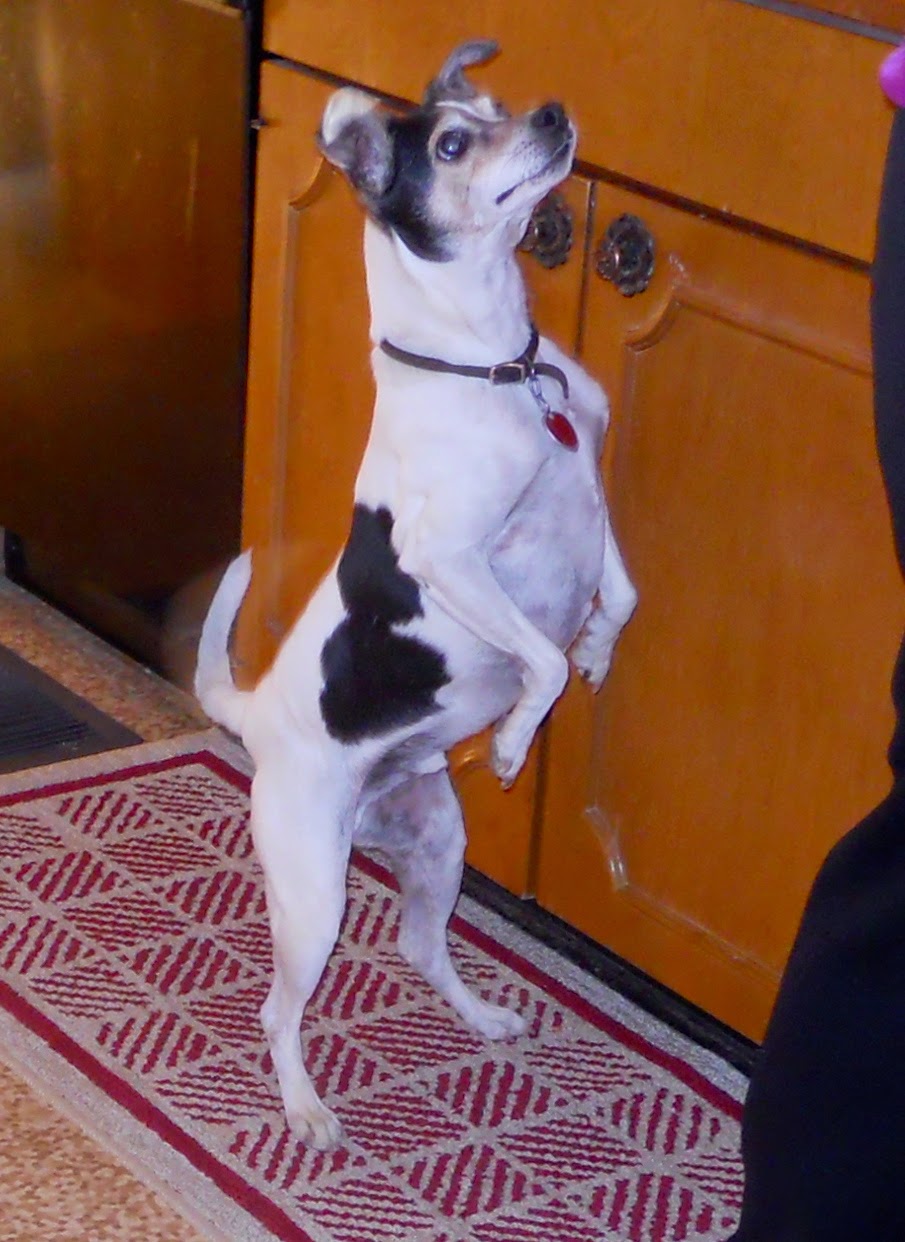
Eric munches, Fred watches |
Which was not an altogether bad thing because around that time my days needed shaping. I'd recently lost my job at the mismanaged company where I worked for most of our time in Texas.
That wasn't an altogether bad thing either because the bombastic, myopic, erratic, neurotic, narcissistic mismanager of the company had me desperately seeking therapy in lieu of suicide. I wanted to quit the job. My very practical wife thought I meant quit in a couple of years when I could retire. I meant RIGHT NOW! before it kills me. I didn't make myself as clear as I needed to. She had worked hard, earned her Ph.D., had things she wanted to do and said she wanted the time to do them. Because I love her, I agreed, but we lived on separate psychic timelines for a while after that. We'd never done that before in our long and happy life. But I kept working, kept going to therapy (so I could keep working). Besides, the erratic, neurotic, narcissistic, etc. mismanager paid pretty well and the health insurance was good (the therapist liked that part).
Then suddenly, surprisingly, the job ended. A guy called me at home to tell me. It was good old Darryl, the ever faithful company guy who would lose his own job to the same mismanaged mess not long after that. Mr. Erratic, Neurotic, Etc., who recently had assured me that he couldn't imagine the company without me and that I could work there as long as I wanted to, never did his own shit work. I was out. And that was that. It was all over but the unemployment checks. I was too furious at the duplicity of it to feel relieved.
I suppose my anger gave my days some shape, but it didn't last. While my wife worked I sank into shapeless days of television, seeking narrative relief for the interrupted job-shaped story of most of my life. Then Fred became diabetic and ladling pee, testing blood sugar and poking needles gave me something to do every day. It still left plenty of time for television. Then, on a day when my wife was away working in Rhode Island and I was watching rerun after rerun of Law and Order on cable TV and eating peanut-buttered saltines, Fred looked up at me from his bed beside my chair and I watched him go blind. It was among the saddest things I'd ever seen and there was nothing I could do to stop it. It was over in a few minutes.
That's when my days took on the dog shape they kept until a couple of weeks ago. They were noisy days from the first. Fred was a good blind dog, but he was a blind dog. He had a talent for understanding words and following directions and I talked him through his blindness. He listened and was remarkably independent for a long time, but grew more and more insecure and dependent as time passed. My days became smaller and smaller as Fred's needs grew larger. He lost his sense of direction. I had to talk to him more and more to get him through his days but he seemed to understand what I was saying less and less. When I got out of bed in the mornings I stepped into a deep terrier-shaped hole. At least that's how it felt by the end.
That was two weeks ago.
Now when I get out of bed I step onto unexpectedly unfamiliar ground. I have been spending my shapeless days lost in a bigger and sadder place. And there have been some days too devoted to TV (narrative relief of the Law and Order sort), but I know they will end. And I know I am not really on unfamiliar ground. I've been here before. I am standing in that undefined and too quiet spot where the dead always leave the living. It is the place where life goes on and things shape up. I know that. I just don't know what new shape my days will take when that happens.
August 12, 2014
FRED: THE INSUFFICIENCY OF TEARS
Our dog Fred died a couple of days ago. He was about 15 years old - ours for 14 of those years - blind, diabetic, arthritic, incontinent, he trembled, had trouble standing, limped when he walked, had to be carried outside, was disoriented, confused, sometimes (often) needed to go outside in the middle of the night but sometimes still peed on the carpet because he couldn't help it, had begun to pant when he walked even short distances. After years of living fearlessly as a blind dog in a big world, his world grew smaller and more insecure by the day over the past few months. Many days lately he seemed to labor at simply staying alive and by the end he didn't have energy for much more than that. We decided it was time to take that little bit away too.
We think people who call themselves pet parents insult both pets and parents. We are dog owners. Ending Fred's life would not be like killing one of our children. But it would be killing something we loved, something we had worked hard for years to keep alive. It was not an easy decision.
I do not believe the dead go to a better place. This is the place and this is the one life any living thing has. After that there is nothing. Of course, the good thing about nothing is that we do not know we have arrived when we get there. But taking away life is taking away everything. Forever. That is not an easy thing to do. We wrestled with it, discussed it, worried it, measured his life and ours, measured his pain and ours, measured his loyalty and ours. "It is what I would want you to do for me. I expect it," Dauna said. I expect nothing less from her. There comes a time when the best thing to do is an act of terrible kindness that never can be undone. We decided it was the best thing we could do for Fred.
We made an appointment for 11:30 last Saturday (making such an appointment was disconcerting). Fred loved to ride in the car and we decided that is where it would be appropriate for him to spend his final minutes. He was calm as we drove him to the veterinarian's office. We parked in the shade of a juniper tree. His bed was in the back seat. Dauna sat beside him. We petted him, talked to him. He was quiet. He never particularly liked strangers touching him, but he remained calm when the vet leaned into the car and petted him, too. She explained the process and made sure we knew what we were doing. It was clear that she understood the difficulty of our decision. She gave Fred a sedative. He slept deeply, quickly, and we could only hope he heard our final goodbyes. The vet came back about 10 minutes later with an assistant, found a vein, gave him another injection - at any time up to that very moment we could have stopped what was happening, but we had agreed it was time to do what we were doing and had labored over the decision for weeks, even earlier that day. Neither of us said stop. In a few minutes, peacefully, quietly, his heart stopped beating and we were in tears.
I had dug his grave between two cactuses the day before. It seemed an appropriate place because Fred had a knack for stumbling over cactuses when he went out hiking with us (something else he couldn't do any longer). It wasn't easy because there is so much disintegrating granite in the soil here and my back still aches a little from swinging the pick and hoisting the shovel, but I dug it deep enough and wide enough, comfortable enough (that's how I thought about it). We brought Fred home and gently put him in the grave wrapped in a favorite blanket and covered him up. My wife fashioned a marker from dead cholla cactus branches, attached his tag to it and we walked away. It was a sad afternoon.
A little later I walked across the arroyo and up the hill alone. Why? I wasn't sure. But it felt like the right thing to do. I stood over the grave and made sure the dirt was snug around him one more time, pressing, packing it with my foot. I turned to walk away. Stopped. Looked down and said, "I'm sorry." I didn't intend to say that, but it was all I could do with my sadness when tears were not enough.
| Fred begging for cucumbers |
I do not believe the dead go to a better place. This is the place and this is the one life any living thing has. After that there is nothing. Of course, the good thing about nothing is that we do not know we have arrived when we get there. But taking away life is taking away everything. Forever. That is not an easy thing to do. We wrestled with it, discussed it, worried it, measured his life and ours, measured his pain and ours, measured his loyalty and ours. "It is what I would want you to do for me. I expect it," Dauna said. I expect nothing less from her. There comes a time when the best thing to do is an act of terrible kindness that never can be undone. We decided it was the best thing we could do for Fred.
We made an appointment for 11:30 last Saturday (making such an appointment was disconcerting). Fred loved to ride in the car and we decided that is where it would be appropriate for him to spend his final minutes. He was calm as we drove him to the veterinarian's office. We parked in the shade of a juniper tree. His bed was in the back seat. Dauna sat beside him. We petted him, talked to him. He was quiet. He never particularly liked strangers touching him, but he remained calm when the vet leaned into the car and petted him, too. She explained the process and made sure we knew what we were doing. It was clear that she understood the difficulty of our decision. She gave Fred a sedative. He slept deeply, quickly, and we could only hope he heard our final goodbyes. The vet came back about 10 minutes later with an assistant, found a vein, gave him another injection - at any time up to that very moment we could have stopped what was happening, but we had agreed it was time to do what we were doing and had labored over the decision for weeks, even earlier that day. Neither of us said stop. In a few minutes, peacefully, quietly, his heart stopped beating and we were in tears.
I had dug his grave between two cactuses the day before. It seemed an appropriate place because Fred had a knack for stumbling over cactuses when he went out hiking with us (something else he couldn't do any longer). It wasn't easy because there is so much disintegrating granite in the soil here and my back still aches a little from swinging the pick and hoisting the shovel, but I dug it deep enough and wide enough, comfortable enough (that's how I thought about it). We brought Fred home and gently put him in the grave wrapped in a favorite blanket and covered him up. My wife fashioned a marker from dead cholla cactus branches, attached his tag to it and we walked away. It was a sad afternoon.
A little later I walked across the arroyo and up the hill alone. Why? I wasn't sure. But it felt like the right thing to do. I stood over the grave and made sure the dirt was snug around him one more time, pressing, packing it with my foot. I turned to walk away. Stopped. Looked down and said, "I'm sorry." I didn't intend to say that, but it was all I could do with my sadness when tears were not enough.
January 30, 2014
HERE I GO AGAIN
I haven't written anything here since last October because I have been writing other things. Lots of other things, fiction, mostly short stories, some of them not so short. And I have been seriously attempting - for the first time in years - to get some of the stories published. This is what I did for many years before my wife and I met 27 years ago. She was a student in a writing class I was teaching. I was having some success back then and had been having some success for several years. But I wasn't happy about it. Being a writer is not a happy way to live. My wife once asked why she never hears me laughing when I am writing funny things. Laughing is for readers not writers. Besides, too much misery goes into even the happiest sentence. When we decided to be married, I decided to retire my misery and allow myself to be happy. And I did. And I am. And I have been for all these years.
Not that I haven't written in all that time. I never stopped.
But now I am back at it in the old way. Steady. Every day. I even published something a couple of weeks ago. It is a story called "Raining Indians" and it is not a happy story . But who could write a happy story set in Gallup, NM? It is the first time I've published a short story in a long time and the first time in an online publication. It's called the Provo Canyon Review. Go to the site, click on the story title. That's all it takes. I like it.
I had a good career as a journalist and editor (with a very strange and unintended finish as a corporate vice president for a business doomed by its maniacal founder and CEO). I had a knack for it. All of it. In fact, I had a talent for it. My old therapist (who saved me from my encounter with the maniac or at least made it possible for me to save myself) once said my journalism career was taking the easy way out and jerked me up short. "You have a gift," he said. "Journalism was easy. Using your gift is difficult."
Now I've retired from journalism. And here I am again. Putting myself in difficulties. And enjoying wrapping my old misery in my gift of language and sending it where it belongs - out on its own. My wife encourages me to keep going but I know she will not love me any less if I stop. All of my years of happiness with her have made a difference for both of us. Joy has returned to writing things down. It took a long time. And the time has come. But this is not what I expected to do. I'm retired.
October 23, 2013
DRIVE, HE SAID/SHE SAID/WE SAID
There was a time when all
someone had to say was, “Let’s go" (somewhere, anywhere), and I would have hopped in the car and said impatiently,
“When are we leaving?” And once the trip was underway I never asked, "Are we there yet?" The joy was in the going, not the getting there, in the passing through, never in the staying. I stopped a few times but never stayed for long. Stopping brings regret. Going does not. Regret doesn't travel well. So I went. And kept going. And had no regrets.
Times change. Now it is going that brings regret. Stopping does not. And I have stopped in a place where I will stay. And it is difficult to leave, even for a few days. But I am on the move again.
October 4, 2013
Subscribe to:
Posts (Atom)